Bridges AI Consulting Logo
    Back to Blog
    Legal Tech|March 11, 2026|7 min read

    Why Lawyers Should Integrate Artificial Intelligence Into Their Practice

    B

    Bridges AI Team

    AI Strategy & Engineering

    Artificial intelligence is rapidly transforming the legal profession. Once viewed as experimental technology, AI tools are now becoming essential infrastructure for modern law firms. From legal research to document review and contract analysis, AI is helping lawyers work faster, manage larger workloads, and deliver better outcomes for clients. For firms that have not yet adopted AI, the question is no longer whether to integrate it, but how quickly they can do so responsibly and securely.

    Artificial intelligence adoption in the legal sector has accelerated dramatically in recent years. Surveys show that AI usage among legal professionals has grown rapidly as firms recognize its potential to improve efficiency and decision-making. According to industry reports, nearly 78% of legal professionals now use some form of AI technology in their work.

    Even more striking is the pace of change. In 2023, only about 19% of law firms reported using AI tools, yet today a large majority of legal professionals report incorporating AI into their workflows.

    Despite this rapid growth, adoption across firms remains uneven. Smaller firms and solo practitioners are still slower to implement AI systems, often due to concerns around privacy, cost, or integration with existing technology.

    This uneven adoption creates a competitive divide. Firms that successfully integrate AI are beginning to operate more efficiently than those relying solely on traditional legal workflows.

    Legal work involves large amounts of information processing: reviewing documents, researching case law, drafting briefs, and analyzing contracts. Many of these tasks are time-intensive but structurally repetitive, making them ideal candidates for AI assistance.

    AI tools can automate or accelerate many of these processes, allowing lawyers to focus on high-value strategic work. Research from the Thomson Reuters Future of Professionals report suggests that AI tools could save lawyers nearly 240 hours of work per year by improving efficiency in routine legal tasks such as document review, research, and contract analysis.

    Additional studies show that over 80% of lawyers using AI report improved efficiency, allowing them to dedicate more time to complex legal strategy and client interaction.

    Instead of replacing attorneys, AI acts as a productivity multiplier, handling information-heavy tasks while lawyers concentrate on legal reasoning, negotiation, and advocacy.

    Legal research is one of the most time-consuming aspects of legal practice. Attorneys must analyze case law, statutes, regulations, and prior legal arguments across large volumes of documents.

    AI-powered legal research tools can process and analyze vast legal datasets far more quickly than traditional methods. These systems can summarize cases, identify relevant precedents, and highlight key legal issues within seconds.

    Research on AI-assisted legal systems shows that integrated AI analysis platforms can reduce preliminary legal research and case assessment time by over 90% compared to traditional workflows.

    For law firms managing large internal knowledge bases (briefs, motions, contracts, and memoranda), AI can also function as a searchable institutional memory. Attorneys can instantly retrieve prior work product and relevant legal strategies from their own firm's document archives.

    AI Improves Document Review and Contract Analysis

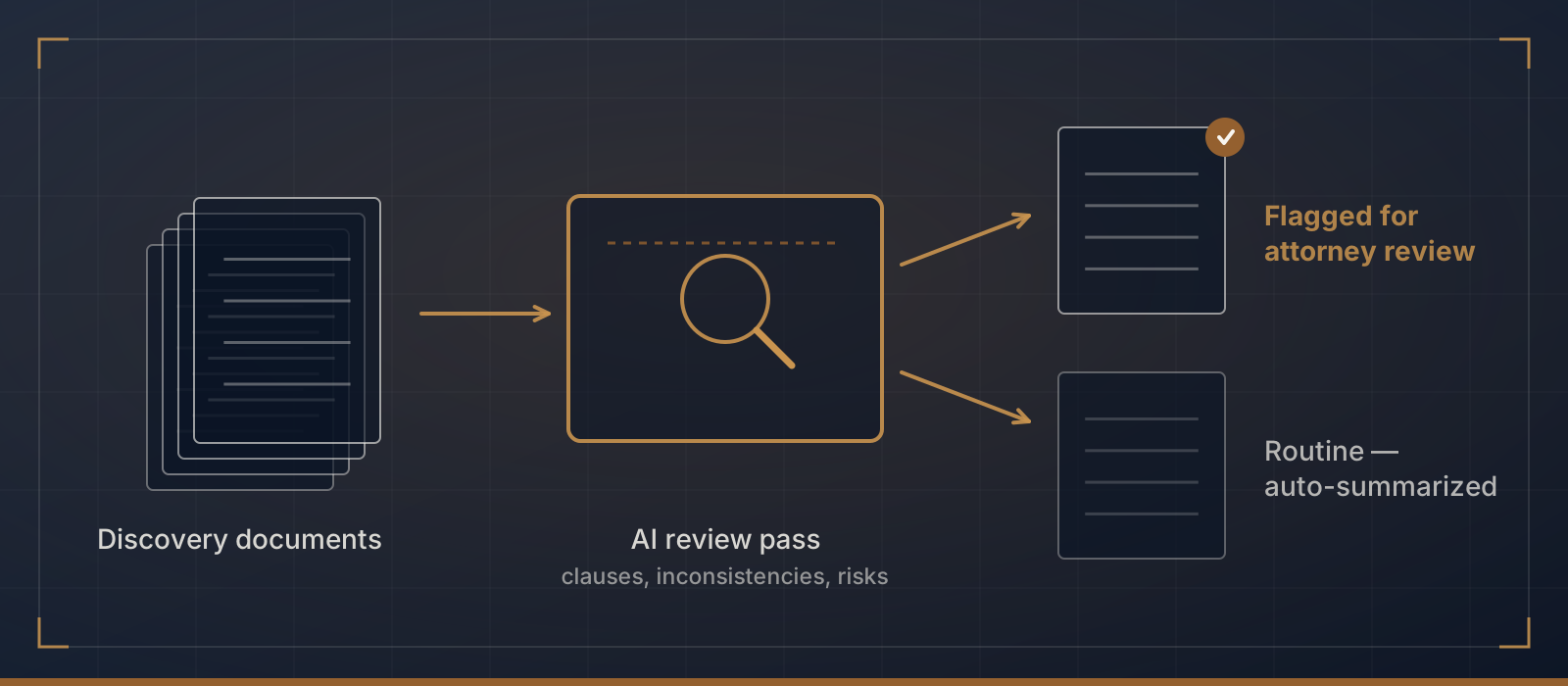
    Document review is another area where AI provides immediate value. Large litigation matters often involve reviewing thousands, or even millions, of documents during discovery.

    AI systems can automatically analyze documents, identify key clauses, detect inconsistencies, and highlight potential risks. This dramatically reduces the amount of manual review required by legal teams.

    Studies comparing human reviewers with AI systems have shown that AI models can outperform lawyers in certain structured review tasks while completing the work far faster. For example, research comparing AI systems to human legal reviewers found that AI could analyze documents in seconds rather than minutes, while also reducing review costs significantly.

    This capability allows lawyers to spend less time reading repetitive documents and more time developing case strategy.

    Clients Are Beginning to Expect AI Capabilities

    Clients are increasingly aware that legal technology can reduce costs and improve efficiency. As a result, many corporate legal departments are beginning to expect their outside counsel to use advanced technology.

    Research indicates that 67% of corporate counsel expect law firms to use cutting-edge technology such as generative AI tools.

    Law firms that resist adopting AI risk falling behind competitors who can deliver faster insights and more efficient legal services.

    One of the biggest misconceptions about AI in the legal field is that it will replace lawyers. In reality, the opposite is more likely to occur. AI tools automate low-value, repetitive tasks, allowing attorneys to concentrate on work that requires judgment, creativity, and legal expertise.

    Rather than spending hours manually summarizing documents or searching databases, lawyers can focus on:

    • Developing litigation strategy
    • Negotiating complex agreements
    • Advising clients on legal risk
    • Building stronger client relationships

    AI shifts legal work away from administrative tasks and toward higher-value professional activities.

    Security and Privacy Must Be Addressed

    Despite its benefits, AI adoption in law firms must be approached carefully. Confidentiality and data security are critical considerations in legal practice.

    Some AI tools operate entirely in the cloud, which may raise concerns about uploading sensitive client information to third-party servers. Law firms must ensure that any AI system they deploy complies with ethical obligations, data protection standards, and client confidentiality requirements.

    For this reason, many firms are exploring private AI infrastructure, where AI tools operate within a firm's own secure systems rather than external cloud environments. This approach allows firms to benefit from AI capabilities while maintaining strict control over client data.

    The legal profession has historically been slow to adopt new technologies, but the rise of AI is accelerating change across the industry. From research and discovery to drafting and knowledge management, AI is becoming deeply integrated into legal workflows.

    Studies show that AI adoption across legal organizations continues to grow rapidly, with many firms planning to make AI tools central to their workflows in the coming years.

    Firms that adopt AI thoughtfully, balancing automation with professional oversight, will be positioned to deliver better legal services, operate more efficiently, and remain competitive in an increasingly technology-driven legal market.

    Conclusion

    Artificial intelligence is not replacing lawyers; it is transforming how they work. By automating repetitive tasks, accelerating research, and organizing large volumes of legal information, AI enables attorneys to work more efficiently and focus on the complex legal challenges that truly require human expertise.

    Law firms that integrate AI into their systems will gain significant advantages in productivity, cost efficiency, and client service. As AI technology continues to evolve, its role in legal practice will only expand. Firms that embrace this transformation today will be better positioned to succeed in the legal landscape of tomorrow.

    References

    • American Bar Association. 2024 Artificial Intelligence TechReport.
    • Clio. Legal Trends Report: AI Adoption in the Legal Industry.
    • DocuEase. AI Statistics in the Legal Field.
    • Legal.io. Law Firms Trail Legal Departments in AI Adoption.
    • Litify. AI Adoption in the Legal Industry Report.
    • Thomson Reuters. Future of Professionals Report: Impact of AI on Legal Work.
    • MyCase. AI Adoption in Law Firms.
    • JD Supra. Top AI Trends Law Firms Must Know.
    • Kalaycioglu et al. AI-Powered Legal Intelligence System Architecture.
    • Whitehouse et al. Better Bill GPT: Comparing LLMs Against Legal Invoice Reviewers.

    Ready to implement this AI strategy?

    Bridges AI helps companies move from research to production with elite engineering.

    Work with us