
Why Your Director's Ratio Should Worry You (And What AI Can Do About It)
Bridges AI
AI Strategy & Engineering
Published annually by the NJ Division of Taxation, the Director's Ratio measures how closely your assessed values track true market value. Below 85%, the consequences compound fast: appeal exposure climbs, tax court filings spike, revenue stability erodes.
How wide is the gap in NJ assessments?
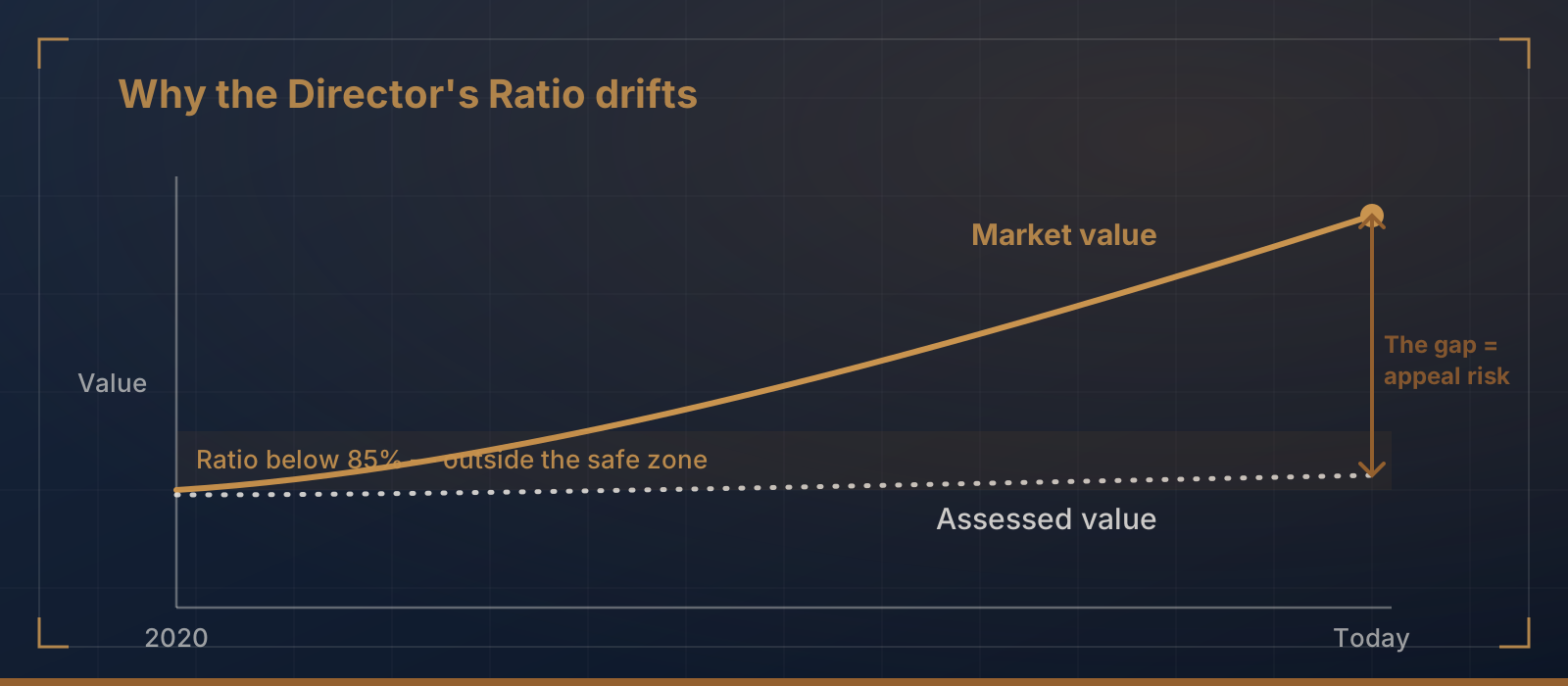
Across New Jersey's 564 municipalities it has widened sharply. Rising home prices since 2020 pushed many towns further from equilibrium, while revaluations stayed expensive and politically fraught. A municipality at a Director's Ratio of 55% is telling owners their homes are assessed at half of market value, an invitation for selective appeals that erode the tax base unevenly.
Which municipalities are most at risk?
Those that haven't revalued in over a decade. Below 60%, the cost of doing nothing exceeds the cost of acting:
- Appeal volume increases as attorneys identify easy targets
- Tax court settlements drain revenue and create precedent
- Inequity compounds as some property classes drift faster than others
- State oversight intensifies, with potential for ordered revaluations
What does modern assessment intelligence do?
Hiring appraisers, inspecting properties one by one, and waiting 18 months is no longer the only option. AI platforms can:
- Analyze every parcel at once. Rather than sampling 10% of properties, models score the entire tax roll against current market data, flagging outliers in minutes.
- Detect physical changes from aerial imagery. Computer vision spots new construction, additions, pools, and demolitions in satellite images over time, catching improvements that never triggered a permit.
- Predict appeal risk before filings arrive. Appeal history, property characteristics, and market gaps show which parcels will be challenged, leaving time to prepare defensible valuations.
- Generate IAAO-compliant uniformity metrics. Coefficient of Dispersion (COD), Price-Related Differential (PRD), and other equity measures across the whole jurisdiction in real time.
Is a full revaluation the only fix?
No. Targeted reassessment of the parcels with the largest gaps improves equity metrics and cuts appeal exposure at a fraction of the cost. It suits municipalities that haven't revalued in 5+ years, sit at a Director's Ratio between 60-85%, are seeing more appeal filings, or need to show progress to the county tax board.
What should assessors do now?
- Know your numbers. Having no current Director's Ratio, COD, and PRD is the first problem to solve.
- Map your exposure. Parcels with the largest assessed-to-market gap are your appeal targets.
- Prioritize by risk. Focus where the gap is large enough to attract attorneys.
The Director's Ratio will not improve on its own, but it doesn't have to become a crisis.
Bridges AI builds assessment intelligence platforms for New Jersey municipalities. If you'd like to see how your municipality's data looks through an AI lens, get in touch.
Related posts
How Satellite Imagery Is Transforming NJ Property Assessment
Computer vision and aerial imagery are giving NJ assessors new tools to detect property changes, verify conditions, and maintain assessment accuracy without knocking on every door.
Property Assessment2026 NJ Appeal Season: The Assessor's Preparation Checklist
Appeal filing deadlines are approaching. Here's a practical checklist for NJ tax assessors to prepare defensible valuations and minimize revenue loss.
Property AssessmentCOD, PRD, and Uniformity: What Every NJ Assessor Needs to Know
IAAO uniformity metrics are increasingly used to evaluate NJ assessments. Here's what COD and PRD mean for your municipality, and how to improve them.