
How NJ Tax Assessors Are Using AI to Win More Appeals
Bridges AI
AI Strategy & Engineering
New Jersey leads the nation in property tax appeal volume. High taxes, an accessible appeal process, and a cottage industry of appeal attorneys keep assessors under constant challenge.
Why do NJ property tax appeals cost so much?
Not in legal fees. Every successful appeal reduces the ratables that fund schools, police, fire, and municipal services, and the reduction becomes the new baseline until the next revaluation.
Exposure is uneven. A homeowner assessed at $300,000 on a property worth $500,000 has no reason to appeal. One assessed at $400,000 when the market says $350,000 is a slam dunk for any tax attorney.
What's wrong with the traditional defense playbook?
Most assessor offices still defend appeals this way:
- Pull the property record card
- Find 3-5 comparable sales
- Make adjustments for differences
- Present the analysis at the hearing
- Hope the board agrees
It is reactive: by the time you pull comps, the appeal is filed. And it doesn't scale. An assessor handling 200 appeals in one filing season can't give each the depth it deserves, so cases settle that shouldn't.
How does AI change appeal defense?
- Predict appeals before filing. Models trained on historical appeals, property characteristics, and market gaps flag likely challenges weeks ahead of the deadline, leaving time to adjust weak cases and fortify the rest.
- Generate comp analysis instantly. Every sale in the jurisdiction and neighboring ones, ranked, adjusted, and turned into a defensible value estimate in seconds.
- Quantify risk. Score each appeal's likely outcome range from property characteristics, the assessed-to-market gap, and past outcomes in similar cases.
- Build defensible narratives. Property-specific write-ups covering methodology, comparable selection, and adjustment rationale, in language suited to a tax board hearing.
What does that look like in practice?
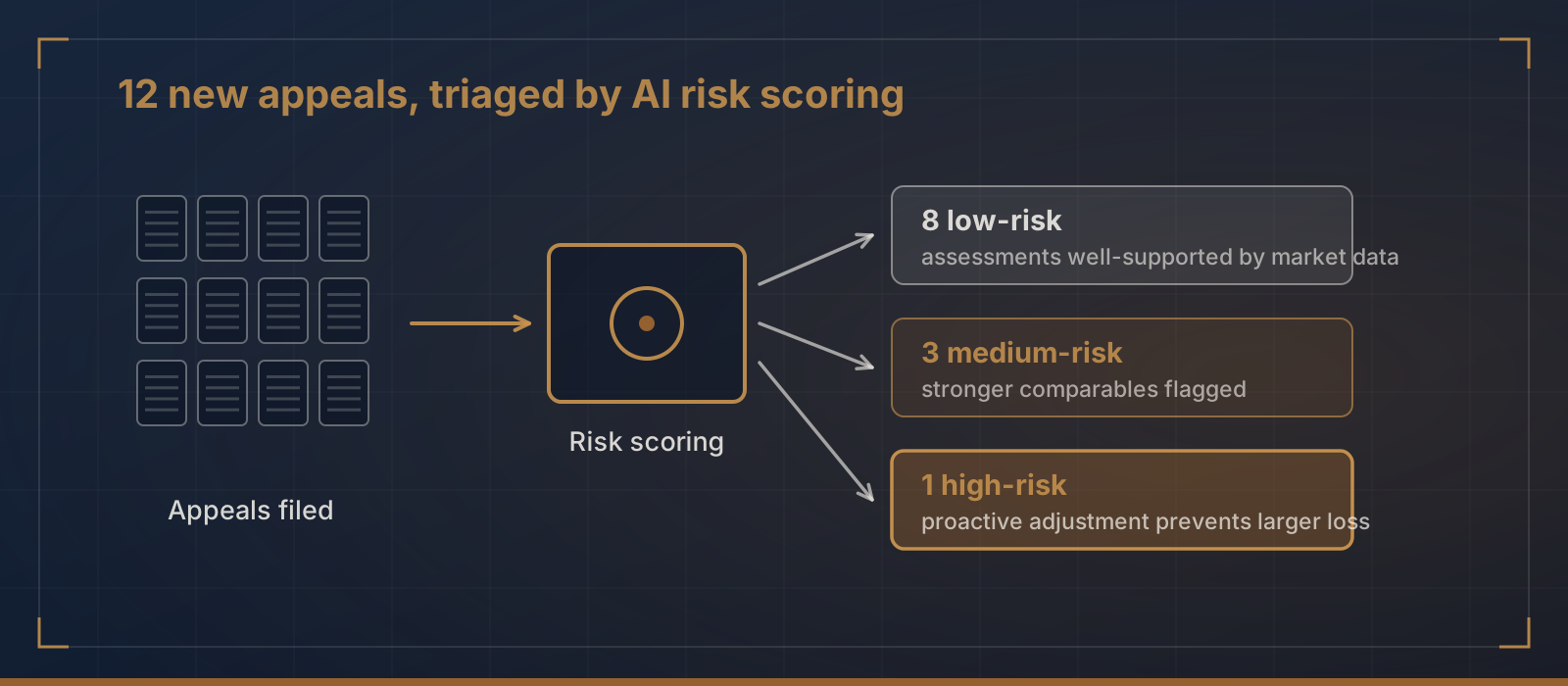
Instead of a stack of appeal notices, a dashboard:
- 12 new appeals filed this week
- 8 are low-risk: assessments well-supported by market data
- 3 are medium-risk: specific comparables flagged that strengthen your position
- 1 is high-risk: the assessment may be indefensible, and a proactive adjustment could prevent a larger loss at hearing
What is the ROI for municipalities?
An unnecessary settlement doesn't cost revenue once; the reduced assessment persists until the next revaluation. Across a season, settlements avoided and reductions kept smaller preserve recurring revenue. Quality compounds too: fewer indefensible assessments on the roll means fewer appeals filed at all. The best time to prepare is before the season starts.
Bridges AI builds appeal defense intelligence for New Jersey tax assessors. See how your municipality's appeal exposure looks with a free assessment audit. Request a demo.
Related posts
How Satellite Imagery Is Transforming NJ Property Assessment
Computer vision and aerial imagery are giving NJ assessors new tools to detect property changes, verify conditions, and maintain assessment accuracy without knocking on every door.
Property Assessment2026 NJ Appeal Season: The Assessor's Preparation Checklist
Appeal filing deadlines are approaching. Here's a practical checklist for NJ tax assessors to prepare defensible valuations and minimize revenue loss.
Property AssessmentCOD, PRD, and Uniformity: What Every NJ Assessor Needs to Know
IAAO uniformity metrics are increasingly used to evaluate NJ assessments. Here's what COD and PRD mean for your municipality, and how to improve them.